
Office and Reception Signage: A Practical Guide
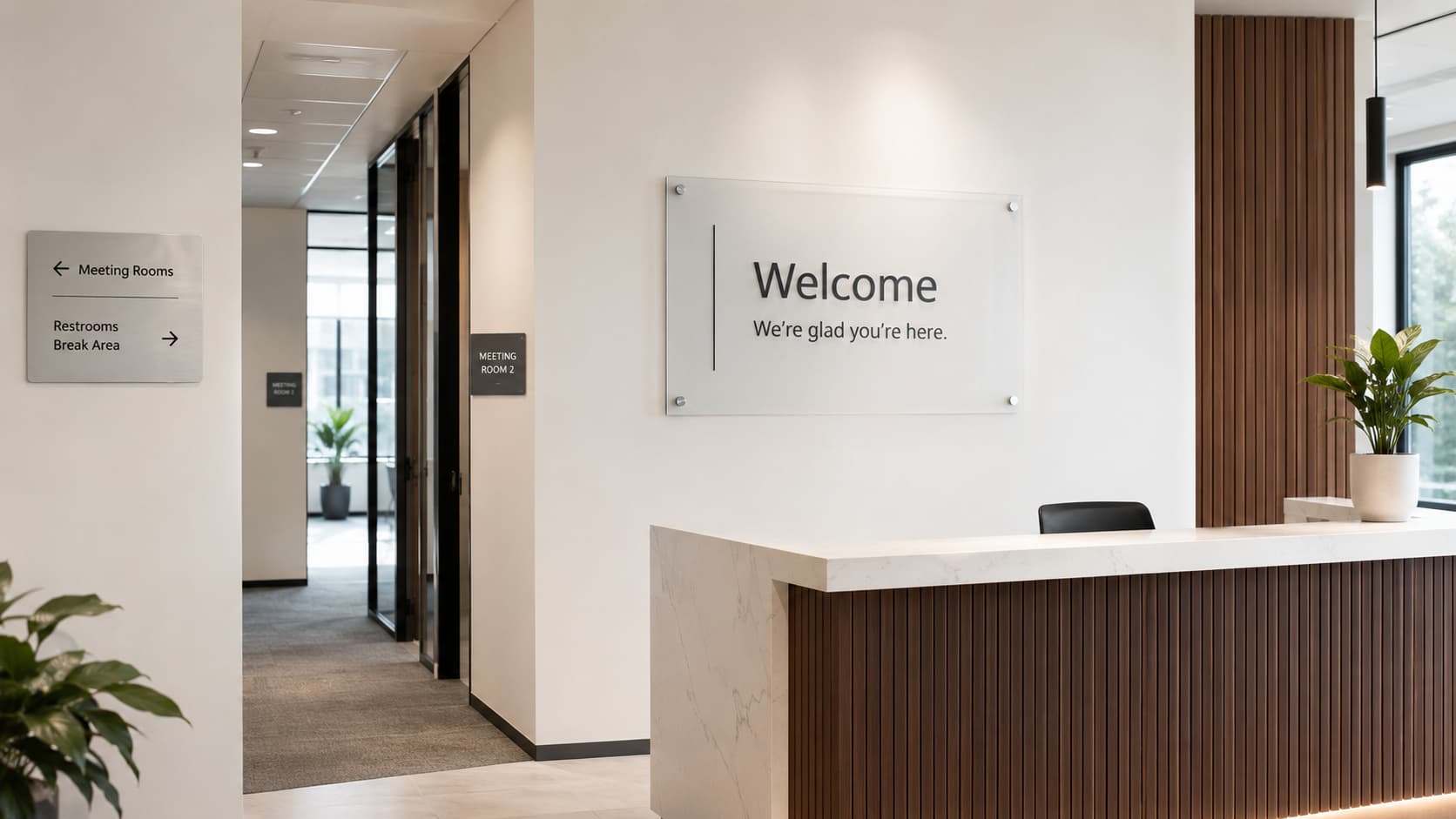
Office signage does more than identify rooms and direct visitors. From reception signs and 3D logos to wayfinding and safety signage, a well-planned sign system helps create a professional, welcoming and easy-to-navigate workplace.
Why Office Signage Matters More Than You Think
Office signs tend to be one of the last things a business thinks about and one of the first things a visitor notices. The reception area is where clients, candidates and partners form their initial impression of your organisation. A well-designed reception sign with a three-dimensional logo, clean materials and considered lighting communicates competence and attention to detail before anyone has spoken to anyone. A printed vinyl banner cable-tied to a wall communicates something rather different.
Beyond the reception, office signage has practical work to do. It helps people find meeting rooms, navigate between departments, locate fire exits and understand the layout of a space they do not know well. In a larger office, poor signage wastes time. Visitors get lost, deliveries go to the wrong floor, and staff spend more time directing people than they should.
This guide covers the main categories of office and reception signage, the materials worth considering, how to keep everything on brand and what to think about when planning a signage scheme for a new or refurbished workplace. It is written for anyone specifying office signage for the first time or reviewing what is already in place.
The Different Types of Office Signage
Most office environments need signage across several categories. Getting a clear picture of the full range before specifying anything avoids the common problem of ordering one type in isolation and ending up with a mismatch across the rest of the space.
- Reception and feature signs — the primary brand statement, usually a three-dimensional logo or built-up lettering on the reception wall
- Door and room signs — identification signs for meeting rooms, offices, toilets, plant rooms and any other named space
- Directional and wayfinding signs — arrow-led signs helping people navigate between floors, departments and facilities
- Health, safety and compliance signs — fire exits, first aid points, accessibility information and statutory notices
- Wall graphics and vinyl — brand graphics, motivational messaging, large-scale prints and decorative elements that contribute to the office environment
- Desk and personalisation signs — name plates, hot-desk identifiers, departmental signs and other staff-facing identification
Not every office needs all of these, but it is useful to think about the full list before starting. The goal is a space where every sign feels like part of the same considered scheme, not a collection of things ordered at different times from different places.
Reception and Feature Signs
The reception sign is the single most important piece of office signage in most workplaces. It is what visitors photograph, what candidates notice during interviews, and what sets the expectation for the quality of the space beyond it. It earns a disproportionate share of the signage budget because the return on it is disproportionate too.
3D logos and built-up letters
Three-dimensional letters and logo shapes mounted directly onto a reception wall are the standard for offices that want their space to feel properly considered. Individual characters or logo elements are cut from acrylic, aluminium, stainless steel or foam and fixed with a standoff so they sit proud of the wall surface. The shadow line this creates adds depth and reinforces the three-dimensional quality of the sign at any time of day.
Illuminated reception signs
Lighting can be added to three-dimensional reception signs in two ways. Face-lit letters shine light through a translucent front face. Halo-lit letters sit against the wall and the light source behind creates a glow around the perimeter of each letter or logo element. Halo lighting is generally considered the more premium option and works particularly well in low-light environments where the glow creates a strong visual effect without being harsh.
Acrylic and metal panel signs
For offices where a flat panel is more appropriate than three-dimensional lettering, an acrylic or metal-faced panel with applied or printed graphics is a clean, versatile option. Frosted acrylic panels with vinyl-cut lettering, brushed aluminium nameplates and printed dibond panels are all commonly used in reception areas and can be specified to match existing interior finishes closely.
Feature walls and brand graphics
Some businesses use the reception area for a larger brand statement beyond the logo sign: a full-height printed wall mural, a vinyl-cut brand pattern, a values graphic or a timeline of the company's history. These are a design decision as much as a signage one, and they work best when they are genuinely integrated with the interior rather than applied as an afterthought.
Door, Room and Desk Signs
Door and room signs are where consistency matters most across a whole office floor. A visitor moving from the reception to a meeting room to a bathroom should encounter signs that feel part of the same system: same material, same format, same typeface, same fixings. When they do not, the space feels unfinished regardless of how good the individual signs are.
Fixed room signs
For permanent spaces, a fixed sign in acrylic, aluminium or brushed steel is the standard approach. These are typically 200 to 300 mm wide and mounted at eye level beside the door. The sign carries the room name, a room number, or both, and may include a Braille or tactile element where accessibility requirements apply.
Interchangeable and modular signs
Hot-desking offices, shared meeting rooms and flexible workspaces need signs that can be updated without replacing the entire unit. Modular systems with insert panels allow the room name or occupant's name to be changed without tools. This is worth specifying from the outset in any workplace that expects its layout or team structure to change over time, which in practice means most offices.
Desk signs and name plates
Desk signs serve a practical function in larger offices where staff are not immediately identifiable by sight: they help visitors and colleagues locate the right person. They also contribute to a sense of permanence and belonging for the staff member. Acrylic and metal desk name plates, printed card holders in branded frames and engraved plates are all options, with the right choice depending on the level of formality and the frequency of staff changes.
Wayfinding and Directional Signage in Offices
Wayfinding in an office context is about making movement through the building intuitive for anyone who does not already know the layout. That means visitors, contractors, new starters and anyone attending a meeting for the first time. The test of a good office wayfinding system is whether someone can navigate from the entrance to their destination without asking for help.
The key decisions are where to place directional signs, what information to include at each point, and how to handle junctions where the path splits. Effective office wayfinding does not try to show everything from every position. It shows the relevant choice at each decision point and trusts that the next sign will appear when it is needed.
For smaller offices with a simple layout, two or three well-placed directional signs are usually sufficient. For multi-floor or multi-building environments, a more systematic approach is needed, with consistent sign families, a clear numbering or naming convention for rooms, and a scheme that can be extended as the business grows.
For more background on wayfinding principles and approaches, our introduction to wayfinding and what is wayfinding posts cover the theory. Our wayfinding signage service page covers how we approach the practical design and installation of wayfinding systems.
Health, Safety and Compliance Signage
Some office signage is not optional. Workplaces in England are legally required to display certain signs under health and safety legislation, and getting this wrong creates liability as well as inconvenience.
- Fire exit signs — required to be clearly visible and on a green background. These must comply with BS EN ISO 7010 and be illuminated or positioned where they are visible in emergency conditions
- Fire action notices — instructions for what to do in the event of a fire, typically posted near fire alarm call points and exits
- First aid signs — identifying the location of first aid kits, defibrillators and first aid personnel
- Accessibility signs — identifying accessible entrances, lifts, accessible toilets and disabled parking where relevant
- Prohibition and warning signs — restricted areas, electrical hazard warnings, PPE requirements and similar
Compliance signs do not have to look like they came from a motorway services. Many businesses specify their mandatory signage in materials and formats that meet the legal requirements while still fitting the aesthetic of the space. There is more design latitude here than most people assume.
If you are fitting out a new office or refurbishing an existing one, it is worth auditing the compliance signage at the same time as the brand signage. Ordering everything from the same supplier means the materials and fixings at least have a chance of looking consistent.
Keeping It On Brand
The most common problem with office signage is not poor individual signs. It is the accumulation of signs specified at different times from different suppliers, each locally reasonable but collectively incoherent. After a few years of additions and changes, the average office has three or four different acrylic finishes, two typefaces, four different fixing systems and a room naming convention that nobody fully understands.
The solution is to specify a sign system rather than individual signs. A system defines the materials, the colour palette, the typeface, the sizes and the fixing method for each category of sign across the whole office. Every new sign ordered fits the system rather than being specified from scratch.
This does not have to be elaborate. For a small office, the system might be as simple as: all room signs are 250mm wide, printed on 5mm white acrylic with brushed chrome standoffs, and use the same font as the brand's printed materials. That is enough to ensure consistency across the space for years.
Brand colour accuracy matters more in an office environment than many businesses expect. A reception logo in a slightly off-brand colour, or a wall graphic printed on a substrate that shifts the hue, is noticeable to anyone who knows the brand. Working with a sign maker who understands colour matching and uses calibrated print equipment avoids this.
Materials and Finishes for Office Signs
Internal signs do not face the weathering and UV exposure of exterior signage, which opens up a wider range of materials and finishes. The right choice depends on the aesthetic of the office, the budget and how permanent the signs need to be.
- Acrylic — the workhorse of internal signage. Available in clear, frosted, coloured and mirror finishes. Takes printed or vinyl-applied graphics well, machines cleanly and gives a contemporary, professional appearance. Suitable for room signs, reception panels and directional signs at all price points.
- Brushed aluminium and stainless steel — the premium material choice for corporate environments. Gives signs weight, permanence and a quality that acrylic does not replicate. Used for name plates, reception feature signs and any application where a high-end metal finish is part of the design intent.
- Timber and MDF — increasingly popular for offices with a warmer, more craft-led aesthetic. Painted or stained timber signs work well in agencies, studios and hospitality businesses. Less common in formal corporate environments but very effective in the right context.
- Frosted vinyl — applied directly to glass partitions and doors rather than a separate substrate. An efficient way to add room identification and privacy to glazed internal walls without additional structure. Works well in open-plan offices with glass meeting rooms.
- Printed dibond and foam board — for directional and informational signs where weight is a consideration or where the sign may need to be updated periodically. Less premium than acrylic or metal but practical for wayfinding and compliance signage where legibility matters more than material quality.
Planning an Office Signage Project
Most office signage projects go more smoothly when the brief is developed before any supplier is contacted. These are the steps worth working through:
- Audit what you have — walk the space and photograph every sign currently in place. Identify what is working, what is missing, what is inconsistent and what needs replacing. This is often more revealing than expected.
- Map the visitor journey — trace the path from the main entrance to the reception, from reception to typical meeting destinations, and from there to exits and facilities. Every point where a visitor makes a navigation decision is a potential sign location.
- Define the sign categories needed — using the types outlined earlier in this guide, list the categories your space requires. Be specific: how many meeting rooms, how many floors, how many toilet blocks, whether compliance signs need replacing.
- Set the specification baseline — decide on the core material, the typeface and the colour palette before specifying individual signs. This is what creates a coherent system rather than a collection.
- Plan for change — offices move people, rename rooms and change layouts. Specify systems that can accommodate this: interchangeable inserts for room signs, a naming convention that scales, and materials that are easy to match if additional signs are needed later.
A signage project is much easier to scope, quote and install when the above thinking has been done in advance. The clearer the brief, the more accurate the quote and the less likely the project is to run into avoidable delays.
How Odysea Approaches Office Signage
We handle office and reception signage projects from initial brief through to manufacture and installation, entirely in-house. For clients specifying a full office scheme, working with one supplier for every sign type means the materials and finishes are consistent across the whole space and the project has a single point of contact throughout.
We start with a consultation to understand the space, the brand and what the signage needs to achieve. For larger or more complex schemes, a site survey is the most efficient way to scope the project accurately. From there, we develop design visuals and a full specification for approval before anything is produced.
We work with businesses across Brighton, Sussex and the South East on office and workplace signage projects of all sizes, from a single reception logo sign through to complete internal sign schemes for multi-floor office developments.
For full details on our internal signage offer, see the internal signs service page. For broader commercial signage, the business signage service page covers the wider range. And for an overview of what we do across Brighton and Sussex, the sign makers in Brighton page is a good starting point.
Ready to Plan Your Office Signage?
Good office signage makes a workplace feel complete. It tells visitors they are in the right place, helps everyone move around without friction and carries the brand into a space where it is seen every working day by the people who matter most to the business. Done well, it is one of the more enduring investments a fit-out budget can make.
If you are planning a new office, refurbishing an existing one or simply reviewing what is already in place, we are happy to help scope the project. A conversation about the space and the brief is usually all it takes to get started.
Book a consultation or get a free quote from Odysea Signs. We respond to most enquiries within 24 hours.
See Our Internal Signs Service Get a Free Quote
What our clients say
about us
