
What Are Monolith Signs? Where They Work and What They Cost
What Is a Monolith Sign?
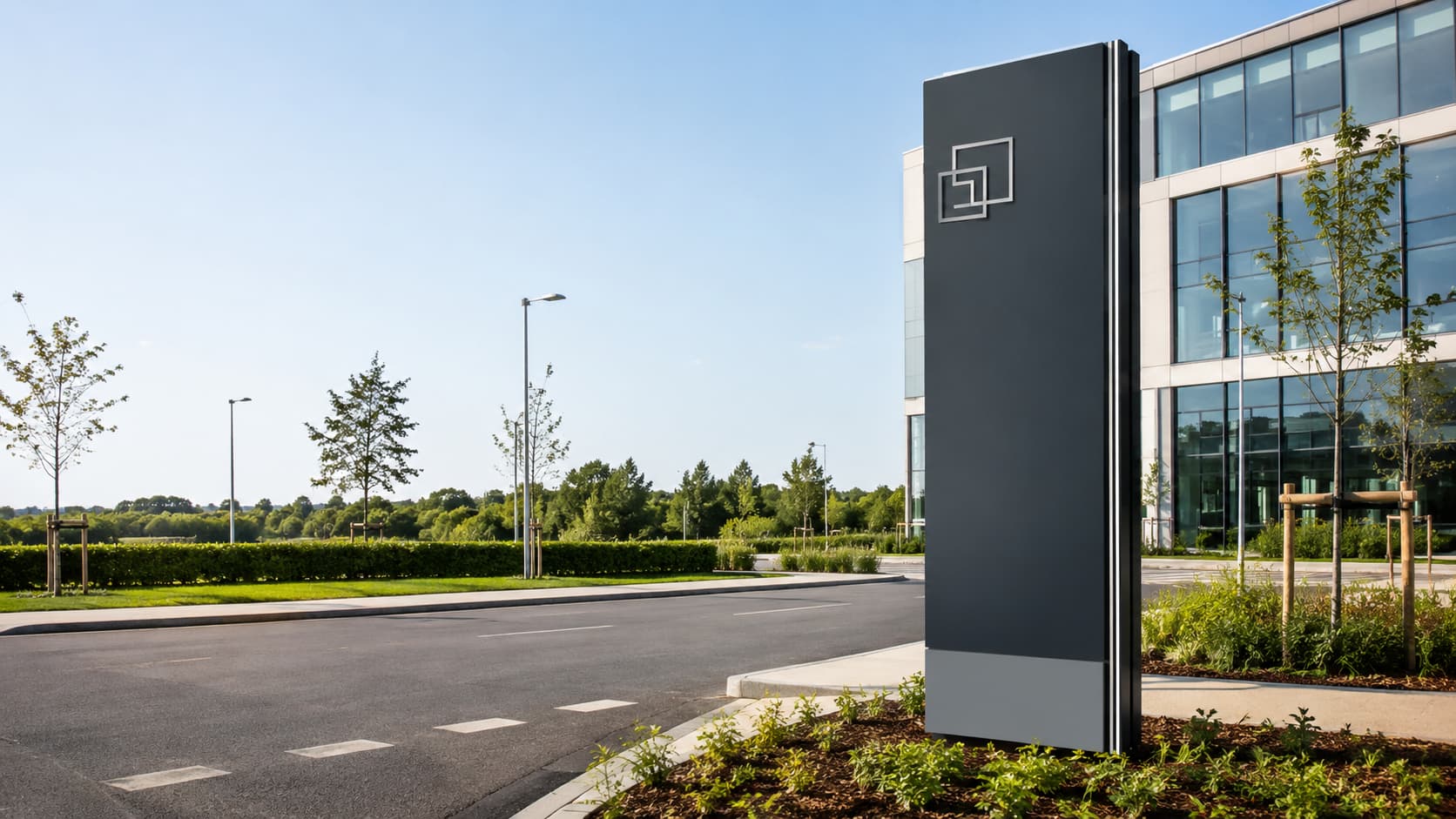
A monolith sign is a freestanding, self-supporting sign structure used to identify a business, site or building from a distance. Rather than being fixed to a wall or fascia, it stands independently in the ground, usually near a site entrance, car park or road junction where it can be seen clearly by people approaching by vehicle or on foot.
Monolith signs are most commonly seen at retail parks, business parks, hotels, schools, hospitals and commercial developments. They range from simple single-sided panels a couple of metres tall through to large illuminated double-sided structures that mark the entrance to a major site. The format suits any situation where you need strong, permanent identification that a building-mounted sign cannot achieve on its own.
If you have been searching for monolith signage, totem signs or freestanding business signs, you are looking at broadly the same category of product. This guide covers what differentiates them, where they work, what materials go into them, how much they typically cost and what the installation process involves.
Monolith Signs vs Totem Signs vs Pylon Signs
The terminology in this category is used loosely and inconsistently across the industry, which causes unnecessary confusion when people are researching their options. Here is a practical breakdown.
Monolith signs
The term most commonly used in the UK for a freestanding sign with a solid, self-contained structure. Typically rectangular, wider than a totem, and built with a substantial base that gives it a grounded, architectural presence. A monolith sign is usually closer to a low-level monument than a tall pole-mounted structure.
Totem signs
A taller, narrower format, more column-like in proportion. Totem signs are often used where multiple tenants or businesses share a site and need to be listed on a single structure. Business parks and retail parks with several occupants commonly use totem signs at the entrance to display each brand in a stacked format.
Pylon signs
A pylon sign is typically the largest of the three categories: a tall, pole-mounted or structural sign visible from a significant distance. Most commonly seen at petrol stations, drive-through restaurants and roadside retail. The scale and installation requirements put pylon signs at the top end of the cost range.
For most commercial and business park applications in the UK, monolith and totem signs are the relevant categories. Pylon signs are usually reserved for high-traffic roadside locations where visibility at distance is the primary requirement.
Where Monolith Signs Work Best
The unifying factor across all the settings below is the same: a building-mounted sign is either not visible enough, not prominent enough at the entrance, or the branding needs to be seen before the building itself comes into view.
Retail parks and shopping centres
A retail park with multiple units and a shared car park needs entrance identification that works before anyone is close enough to read a shopfront fascia. A monolith sign at the site entrance identifies the development and can carry individual tenant branding. In larger parks, totem signs list all occupants in a single structure, giving each brand proportional visibility.
Business parks and office developments
Business parks use monolith signs both at the main site entrance and within the park to identify individual buildings or units. A well-designed entrance monolith sets the tone for the development and makes it easy for visitors and deliveries to locate the right building without relying on a map.
Hotels and leisure facilities
Hotels, health clubs, leisure centres and golf clubs regularly use monolith signs because the building entrance is often set back from the road and the car park needs clear identification from the approach. The sign also carries brand value: a well-built, illuminated monolith at the entrance communicates something about the quality of the venue before anyone walks through the door.
Healthcare and education
Hospitals, GP surgeries, care homes, schools and college campuses all use freestanding signs to identify the main entrance and support wayfinding across the site. These applications often require the sign to carry essential directional information as well as site identification, and the legibility requirements are correspondingly high.
Car parks and site entrances
A monolith or totem sign at a car park entrance or site gateway serves a practical navigation function as much as a branding one. It confirms to visitors that they are in the right place and can be combined with directional information to reduce confusion on larger sites.
Materials and Construction
Monolith signs are built to last. Unlike printed panels or window graphics, a freestanding sign structure is a long-term investment and the materials need to reflect that. These are the most common builds:
- Aluminium composite and aluminium extrusion — the most common structural choice. Lightweight, weather-resistant and available in a wide range of powder-coat colours and finishes. Aluminium frames with composite panel faces are the standard for most commercial monolith signs and offer excellent longevity with minimal maintenance.
- Stainless steel — used for premium corporate and contemporary applications where a polished or brushed metal finish is part of the design intent. More expensive to produce than aluminium but highly durable and visually distinctive.
- Acrylic and built-up letters — acrylic face panels are standard for illuminated monolith signs where light needs to transmit through the sign face evenly. Built-up three-dimensional letters in acrylic or aluminium can be added to the face for a more premium, three-dimensional appearance.
- Concrete and brick bases — some monolith signs, particularly those in a more architectural or heritage setting, use a masonry base rather than a fabricated metal one. These are more involved to install but can integrate well with the surrounding landscape.
- Vinyl and digitally printed graphics — the face panels of most monolith signs carry printed or vinyl-applied branding rather than being painted directly. Printed graphics on high-quality outdoor vinyl last well and can be updated without replacing the entire structure when a rebrand is needed.
Finish choices across all materials include powder-coat paint in any RAL colour, anodised aluminium, brushed steel and various textured surfaces. The right choice depends on the setting, the building's architectural character and the client's brand guidelines.
Illuminated vs Non-Illuminated Monolith Signs
Whether a monolith sign needs illumination depends on how the site operates, how it is positioned relative to passing traffic, and what the sign is expected to achieve after dark.
When illumination is worth it
If the business trades in the evening, if the site entrance is on a road where passing traffic is the primary audience, or if the sign needs to be visible and legible in low light, then illumination is rarely optional. A non-illuminated sign at a hotel entrance, a petrol station or a retail park is essentially invisible after dusk.
Internal illumination
The most common illuminated option for monolith signs. LED lighting is fitted inside the sign cabinet and shines through a translucent acrylic face, illuminating the graphics evenly. LED is now the standard across the industry due to lower running costs and longer service life compared with fluorescent alternatives.
Halo-lit and face-lit built-up letters
For monolith signs with three-dimensional lettering, face-lit letters (where the light shines through the letter face) and halo-lit letters (where the light glows around the letter edges) are both options. Halo-lit tends to look more premium and is a popular choice for hotel and corporate applications.
Non-illuminated
For sites that operate only during daylight hours, or where the sign is in a well-lit position with no visibility requirement after dark, a non-illuminated structure is a practical and cost-effective choice. Conservation area constraints can also make non-illuminated the easier route to planning consent.
For more detail on illuminated sign types and options, see our illuminated signs service page.
Branding and Wayfinding on Monolith Signs
A monolith sign does two jobs simultaneously. The first is identification: it confirms where you are and, for multi-tenant sites, who occupies the development. The second is wayfinding: it orients the visitor and points them in the right direction before they have left the entrance.
Getting both right in a single structure requires some thought. A sign that carries five tenant logos, directional arrows, a site name and a street address all at the same scale will be difficult to read from a moving vehicle. Effective monolith sign design prioritises hierarchy: the site name or primary brand is the dominant element, tenant information is secondary, and directional content is tertiary and positioned where it is actually useful rather than decorative.
For larger sites where wayfinding extends beyond the entrance sign, a monolith at the gateway is typically the first element in a wider directional system that continues through the site with post-mounted and wall-mounted signs. We design these as complete systems rather than individual pieces, which keeps the visual language consistent and the navigation logical.
More detail on integrated wayfinding schemes is on our wayfinding signage page.
How Much Do Monolith Signs Cost?
Monolith sign costs vary more than almost any other sign type because the range of sizes, materials and specifications is so wide. A compact non-illuminated aluminium sign for a small business car park is a very different project from an illuminated double-sided totem for a large retail development. That said, here are rough guidance bands:
- Small non-illuminated monolith (up to 1.5m, single-sided) — £800 to £1,800 installed — suitable for car park entrances, small business parks and site identification
- Medium non-illuminated monolith (1.5m to 2.5m, single or double-sided) — £1,500 to £3,500 installed — standard commercial and business park applications
- Illuminated single-sided monolith (medium scale) — £2,500 to £5,000 installed — hotels, retail, healthcare and any site requiring after-dark visibility
- Illuminated double-sided totem (multi-tenant, medium height) — £3,500 to £8,000+ installed — business parks and retail sites with multiple occupants to list
- Large pylon or tall totem (roadside, high-visibility) — £6,000 to £15,000+ — petrol stations, drive-throughs and high-traffic roadside applications
All prices are rough guides excluding VAT. Groundwork, foundation costs and any electrical supply for illuminated signs are included in the installed price estimates above, but unusual ground conditions or significant cable runs can increase those costs. Planning and advertisement consent fees, where needed, are additional.
Fleet or multi-sign projects covering several entrance points or a phased site development are usually quoted with the full scope in mind, which can affect the per-sign cost.
Planning, Installation and Groundwork
Monolith signs require more involved installation than wall-mounted or fascia signs. A freestanding structure needs to be fixed into the ground securely, which means groundwork, foundations and in most cases a concrete base or anchor system suited to the specific sign size and weight.
For illuminated signs, a power supply needs to reach the sign base, which may require a cable run from the nearest power source. This is usually planned and costed at the survey stage. Most illuminated monolith installations use LED drivers and control gear housed within the sign cabinet itself.
Advertisement consent
Most freestanding signs in England require advertisement consent from the local planning authority rather than full planning permission. Deemed consent covers a limited range of smaller signs in unrestricted locations, but any sign over a certain height or illumination level, or located in a conservation area or near a listed building, will need a formal application.
The process is not usually difficult for a straightforward commercial monolith sign, but it adds time to the project. Applications take a minimum of eight weeks to determine and may require the design to meet specific criteria around size, illumination levels and materials. In conservation areas, those criteria can be considerably more restrictive.
We advise on consent requirements at the quoting stage and can manage the application process on your behalf where needed. Getting this right at the start avoids delays and the cost of having to modify a sign after installation.
How Odysea Designs and Builds Monolith Signs
We handle monolith sign projects from initial design through to groundwork, installation and commissioning, all from our Brighton base. Design, fabrication and fitting are managed by our own team without outsourcing, which keeps the brief intact from the first meeting to the finished installation.
The process starts with a site survey and a brief to understand the location, the visibility requirements, the brand guidelines and any planning constraints. From there, we develop design visuals and a specification for approval before anything goes to production. Groundwork and foundation requirements are assessed as part of the survey so there are no surprises at the installation stage.
We work on monolith sign projects across Sussex, the South East and nationally for clients who need consistent signage across multiple sites. Single-site enquiries are as welcome as multi-site programmes.
For full details on our monolith sign service, see the monolith signs page. For related reading on outdoor commercial signage more broadly, the outdoor signs service page and our shop front signs guide cover the adjacent territory.
For businesses whose signage needs go beyond the entrance sign into wider commercial or corporate environments, the business signage service page covers that range.
Next Steps
A monolith sign is a long-term asset. The right one identifies your site clearly, carries your brand with authority and keeps working without attention for ten or more years. The wrong one, usually the result of cutting corners on materials, installation or planning, creates problems that cost more to fix than the saving was worth.
If you are planning a new freestanding sign for a site entrance, a business park, a car park or a commercial development, we are happy to discuss the options and give you a clear, honest quote based on the actual requirements.
Get a free, no-obligation quote from Odysea Signs. We respond to most enquiries within 24 hours.
[ See Our Monolith Signs Service ] [ Get a Free Quote ]
What our clients say
about us
